stats

Friday, 21 May 2010

Listening - part two

In my previous post I wrote about the privilege and necessity of listening to one another.  In our rushed and hectic world, even in the church, this is often forgotten and overlooked.  We always seem to put doing  above being.
The supreme form of listening of course is listening to God.  Our God wants a two-way fellowship with his children.  Often we usually make it a one-way fellowship.  We come to God with our spiritual shopping list and bombard Him with our requests.  We rarely stop to listen to  what he has to say.  In the end the whole thing is in danger of becoming boring and sterile. 
George Muller of Bristol was an immensely influential figure in the nineteenth century.  he said that the secret of his effectiveness was his determination to keep his soul happy in the Lord.  He did this by regular scripture reading and listening to God in the morning.  I quote his words.


    I saw more clearly than ever that the first great primary business to which I ought to attend every day was, to have my soul happy in the Lord . . . not how much I might serve the Lord, . . . but how I might get my soul into a happy state, and how my inner man might be nourished. For I might seek to set the truth before the unconverted, I might seek to benefit believers . . . and yet, not being happy in the Lord, and not being nourished and strengthened in my inner man day by day, all this might not be attended to in a right spirit. Before this time my practice had been . . . to give myself to prayer after having dressed myself in the morning.
      Now, I saw that the most important thing I had to do was to give myself to the reading of the Word of God, and to meditation on it, that thus my heart might be comforted, encouraged, warned, reproved, instructed; and that thus, by means of the Word of God, whilst meditating on it, my heart might be brought into experimental communion with the Lord.


    In the first half of the  twentieth century the Oxford Group was very influential.  Although I think that their emphases were a bit one sided and unbalanced,  they did introduce the idea and the practice of listening to God to many Christians.  Their practice was quite simple;  chose a quiet place, preferably in the morning, get yourself relaxed, take a pencil or pen and a clean sheet of paper, then simply make your mind receptive to God. Write down whatever comes to you even if it seems a bit odd.  At the end of your session delete whatever is obviously foolish or erroneous.   
    As you persevere you will be surprised what comes.   


    Thursday, 13 May 2010

    Listening

    People are so busy these days that a constant complaint often heard is that nobody seems to listen.  Often a person is speaking about something that really is important, but the listener, by his body language and shifting eyes, gives the infallible impression that he isn't paying attention. Or a person begins to speak about their family  or their inner problems when their listener immediately begins to talk at length about themselves. Some people have the ability to spend a long conversation talking solely about what concerns them. 


    Perhaps the most common complaint that wives make to their husbands is this, "I don't want you to rush and sort out the problem; I just want you to listen to me and truly hear me." 


    I have found an excellent quotation written by Dietrich Bonhoeffer while he was running a sort of illegal seminary in Finkenwalde in the Baltic region.


    LISTENING

    The first service that one owes to others in the fellowship consists in listening to them. Just as love to God begins with listening to His Word, so the beginning of love for the brethren is learning to listen to them. It is God's love for us that He not only gives us His Word but also lends us His ear. So it is His work that we do for our brother when we learn to listen to him. Christians, especially ministers, so often think they must always contribute something when they are in the company of others, that this is the one service they have to render. They forget that listening can be a greater service than speaking.
    Many people are looking for an ear that will listen. They do not find it among Christians, because these Christians are talking where they should be listening. But he who can no longer listen to his brother will soon be no longer listening to God either; he will be doing nothing but prattle in the presence of God too. This is the beginning of the death of the spiritual life, and in the end there is nothing left but spiritual chatter and clerical condescension arrayed in pious words. One who cannot listen long and patiently will presently be talking beside the point and be never really speaking to others, albeit he be not conscious of it. Anyone who thinks that his time is too valuable to spend keeping quiet will eventually have no time for God and his brother, but only for himself and for his own follies.

    Tuesday, 4 May 2010

    Toc H and Tubby Clayton

    Almost exactly three years ago a friend and I  decided  to visit the war graves of northern France and Belgium.  We had both lost uncles in the Great War.  We decided to base ourselves in the beautiful medieval  town of Ypres, fondly known as Wipers by many thousands of British soldiers.  This town, almost totally destroyed in the war, has been painstakingly rebuilt and the ancient cloth hall in the main square is a marvellous piece of architecture.


    The land towards the  east of Ypres is an area that has seen more bloodshed and vicious fighting than almost an area on the  planet.  Wherever you travel you are met with neat and tidy British cemeteries,  with row after row  of simple white tombstones edged carefully with flowers.  It is a quietly moving experience to travel to the town that epitomises the senseless slaughter of 1917, the small Flemish town of Passiondale, the very name of which seems to evoke profoundly sad memories.  (I was told, however, that the word has no associations with the Latin word, passio, to suffer).  I remember sitting quietly drinking coffee is a small cafe in the main square,  thinking about the savage fighting that led to its capture during the Third Battle of Ypres in 1917. It all seemed so unreal. 


    We left Ypres for a day and travelled to the market town of  Poperinge.  We wanted to pay a visit to Talbot House.  It was here that Rev. Tubby Clayton (1885-1972) exercised a profound ministry to the troops. He and another British officer bought a large town house near the centre and opened it as a place of rest and refreshment to the  thousands of British troops who were billeted nearby. It was a remarkable place where troops could rest, read, think and pray in a peaceful atmosphere.  It was probably the  only place on the Western Front where all notions of rank were ignored and men could mix and socialise in total freedom.  
    Probably the most important room in the building was the chapel, which was built in the former storage area for hops at the top of the house.  A carpenters bench was the altar, which is still there today.  Though Clayton was a High Anglican he welcomed men of all denominations or none.  The services were often packed with men sitting on the stairs leading to the loft.  Clayton knew that many who attended would die within a few weeks. Many sought him out and made their peace with God.  
    There was an amazing atmosphere of peace and friendship in the house and garden.

    The chapel as it is today.


    The garden where war-weary men could forget the war for a while.


    No pessimism, an amazing statement to make in 1917!


    There is a story about Tubby Clayton that I find very moving.  One day he was on the battlefield and he arranged a simple communion service right in the midst of the fighting.  As the men knelt in prayer a large shell exploded overhead.  These shells were very lethal, because their casings would disintegrate into thousands of pieces of shrapnel.  When they lifted their heads they noticed that the surrounding  trees and bushes were shredded but the grass and bushes next to them were unscathed.


    After the war many wanted to retain the fellowship and friendships they had experienced in the war.  The Toc H movement came into being.


    In researching the life of this remarkable man I came across a simple poem that he wrote towards the end of his life, a sort of plea for mercy at the resurrection. I found it a very moving poem,


    Lord Jesu, redeemer,
    Wilt wake an old dreamer?
    Of workers the weakest,
    Of liegemen the least,
    Of fainthearts the faithless,
    Of saints' scars the scatheless,
    Wilt robe in redemption a fool for thy feast?


    Sunday, 25 April 2010

    Spring in Cottenham


    Spring, though very late, has finally arrived in southern England.  I took these photos at my daughter's house just north of Cambridge.


    This is an example of the Imperial Fritillary,  probably the most glorious of spring bulbs.


    I was in my daughter's kitchen and I noticed this delightful orchid sitting on the window sill.  I looked around and saw another nearby, this time a mauve orchid.

    It is so easy to take reasonable close-ups with even simple digital camera these days.


    The shot below is of the popular magnolia soulangena, a hybrid bred by a French cavalry officer in 1820.  This glorious tree is very popular in the south of England.


    Saturday, 24 April 2010

    The Psalms and Bible translation

    When you look into church history you begin to realise just how central a role the reading and singing of the psalms were in traditional Christianity.  The monks went through the whole collection each week: this makes it about twelve psalms a day.  The Anglican Book of Common Prayer aims at reading the collection in about thirty days.
    Things are very different today.  In the spontaneous atmosphere of the average charismatic or evangelical service it would be rare to have  just one read.  This is a pity because the psalms speak to the heart.  They don't contain eschatologhy or prophecy or doctrine.  They are mainly concerned with the trials that beset every believer and the duty and privilege of worshipping and trusting God whatever the circumstances.


    I have been reading Psalm 6 today, reading it in the RV ( a revision of the AV), probably the most literal version that has ever been produced.  Although the wording may seem quaint to modern ears yet  I feel its strong imagery speaks directly to the heart.


    The psalmist here is in dire straits.  He feels that the judgement of God is upon him because of his misdeeds.  Added to this he feels the bitter hatred of his enemies, whether they be spiritual or natural.


    As in common in the Psalms there is a lament followed by a resolution.


    I am withered away....for my bones are vexed,
    My soul is also sore vexed.
    I am weary with my groaning;
    Every night I make my bed swim;
    I water my couch with my tears;
    Mine eye wasteth away because of my grief.


    But there us hope:


    Save me for thy lovingkindness' sake.....
    For the Lord hath heard the voice of my weeping.
    For the Lord hath heard my supplication;
    The Lord will receive my prayer.


    The key word in the psalm is the Hebrew word  hesed, translated here by lovingkindness.  It refers to the Lord's kindness and loyalty based on His covenant promises.  Nothing can be firmer or more comforting.


    Maybe a comment on translations of the Bible might be of interest.  There are two approaches to translation of any ancient text:  formal equivalence and dynamic equivalence.  Formal equivalence sticks closely to the original  in sentence structure, grammar and imagery.  The supreme example of this is the version that dominated protestant church life for 350 years, the AV.  The AV reigned supreme during this period.  When I became a Christian in 1953 it was virtually the only Bible in use.  The only other available was Moffatt's translation.   This was generally frowned upon as being too liberal, though I found it helpful when reading the book of Job and other difficult books.
    The most  prominent example of dynamic equivalence is the Good News Bible.  This version uses completely up to date English and avoids all strange idioms and modes of expression.
    The popular NIV, which seems to be the equivalent of the AV in the British church today, lies midway between the two extremes.


    But across the Atlantic things can be different.  American Christians tend to be more conservative.
    Some ultra conservative Christians in the States are suspicious even of the NIV.  They feel that it has lost much of truth and power of the old version.  They find what they feel are heretical alterations in its text, for example in Isaiah 14, where Lucifer is altered to the morning star. 
    I saw an amusing Utube clip the other day of some young men hurling the book around in a church and then burning it.  It finished off when one guy pulled out a gun and shot it! 
    Most of the criticisms they made can be simply explained by advances in our knowledge of Hebrew since 1611 and the much more ancient and reliable texts available today.  

    Saturday, 17 April 2010

    Freedom of speech

    It seems that  there is a growing trend, especially in the UK, that is trying to hinder vigorous intellectual debate in certain sensitive areas.  We are becoming as a nations increasingly mealy-mouthed.  The idea of Hate Crime has  been  put on the statute book.  This would ban nearly all serious critical debate on cultures and religion.  Our country. which  has always prided itself on its insistence that there should be freedom of expression, is lurching in a strange direction. 
    Today, for example, a conservative, who  gets into a fierce debate with a revolutionary Marxist and the latter takes an offence to the remarks made, can be prosecuted.  Recently two hoteliers were taken to court in Liverpool as a result of an argument they had with a Muslim guest.  Fortunately the case was thrown out by the judge.  If this law was stringently applied to the letter then Prime Minister's Question Time would undoubtedly be banned! 
    George Orwell in his book Nineteen Eighty Four was uncannily prescient.  The only thing he got wrong was the timing. He was about 25 years too early.  He mentions Thought Crime and an artificial language called Newspeak.  In the dictatorship he described, the ability to think and to speak unacceptable thoughts was thoroughly crushed.  He makes the remark that Newspeak, the artificial language created by the tyrant, was the only language in the world that has a shrinking vocabulary.  All dangerous words would be excised from the dictionary.  
    I have been surprised  by the freedom that Americans seem to enjoy in this area. Recently I watched a series of videos, originally given in public, made  by a rabbi concerning the chaotic situation in the Middle East.  As I sat there I thought, this guy would never get away with giving these lectures in a public arena in the UK  Then I saw a very funny spoof debate about Islamic terrorism that would be totally banned over here.


    In Holland a fascinating event took place recently.  The controversial politician Gert Wilders, who has been a thorn in the side of the liberal establishment for his anti-Islam stance,  has been taken to court, charged with inciting religious hatred.  But the whole thing has misfired.  Such is the public interest in the case that the trial has been given lots of time on TV.  His defence was very powerfully and eloquently put.  He said that for years now the Christian religion has been mocked and traduced and blasphemed in the media.  Jesus has been portrayed as a homosexual, a pop-star, as the lover of Mary Magdalene and even as a baby in nappies.  Yet no hue and cry has been made and, even more significantly, no one has been taken to court.  Wilders went on to say that he had made a short video on the inherent violence of the quran and he finds  himself in court. 
    Such was the public interest and sympathy in the case, the authorities seemed to have panicked and made the surprising move of stopping it.  It will be resumed after the election, they say.


    The following quotation was written by Winston Churchill in one of his earlier books.  No newspaper or magazine or publisher would touch it today.


    "How dreadful are the curses which Mohammedanism lays on its votaries! Besides the fanatical frenzy, which is as dangerous in a man as hydrophobia in a dog, there is this fearful fatalistic apathy. Improvident habits, slovenly systems of agriculture, sluggish methods of commerce, and insecurity of property exist wherever the followers of the Prophet rule or live. A degraded sensualism deprives this life of its grace and refinement; the next of its dignity and sanctity. The fact that in Mohammedan law every woman must belong to some man as his absolute property - either as a child, a wife, or a concubine - must delay the final extinction of slavery until the faith of Islam has ceased to be a great power among men.”

    Wednesday, 14 April 2010

    Canterbury

    I have just spent a couple of days in Canterbury. As well as having the most important cathedral in England it can boast of an amazingly  long history.  As a result of German bombing in 1942 many archaeologists were able to search through the rubble. They found a lot of evidence of a large and sophisticated Roman town. It had rich villas, temples, baths, a theatre and fine examples of Roman mosaic pavements. But the town declined considerably after the legions left in about 415 AD.
    From 1185 it became the main place of Christian pilgrimage in Great Britain as a result of the martyrdom of St. Thomas a Becket.  Hundreds of thousands visited the town, bringing fame and prosperity.  Chaucer set his masterpiece, The Canterbury Tales, in the Tabard Inn, among a group of pilgrims waiting to start their journey from London to Canterbury.  Chaucer made a very bold and important move to use the new language of English and not the usual Norman French of educated classes.  
    The pilgrimages lasted till 1538, when Henry the Eighth closed all the nearby monasteries and gave orders that the shrine of a Becket should be destroyed and his bones scattered.  His zeal was motived less by protestant piety than by greed to plunder the rich monastic lands.


    A typical late medieval part of the nave


    As you can see, the choire was built during the Norman period, with its emphasis on the rounded arches.


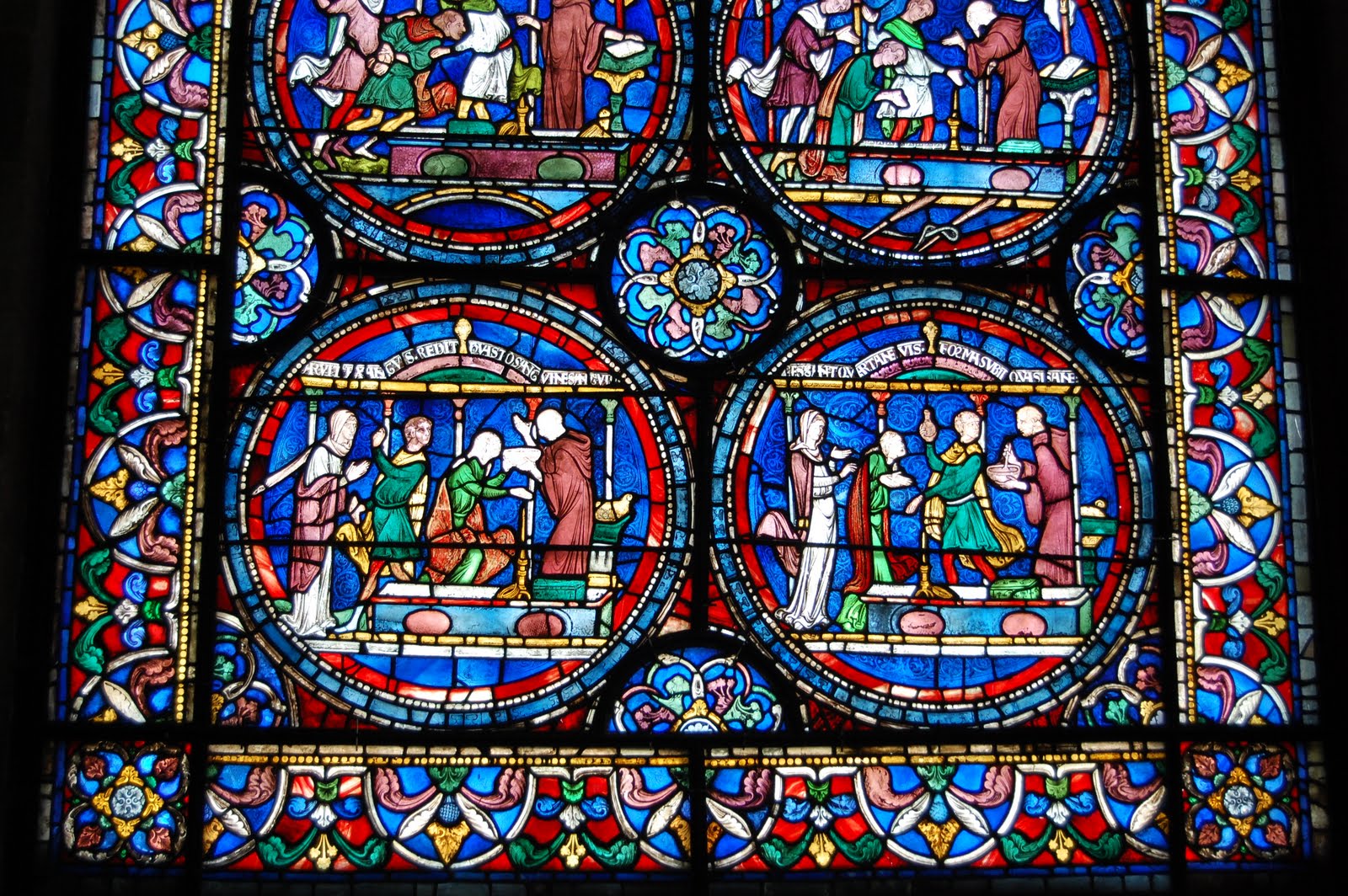
    There aren't many stained-glass windows in the Cathedral.  During the time of Cromwell the Puritans smashed most of them and even used the nave as stabling for their horses.  This is a fine example of modern stained glass.


    In the sixteenth century thousands of  devout Huguenots fled from the religious persecution of all things protestant in France and many settled down in Canterbury.  The town benefited immensely.  The were skilled cloth workers and skilled in other trades.  The town prospered and at one time a third of the population spoke French.  Even to this day there is a regular service in the Cathedral in French every Sunday.  The picture above shows a white riverside building called the Weavers.  It is now a restaurant but its site commemorates the central place of weaving in the past.
    This spring scene was taken near the famous West Tower of the town.  An extensive and attractive garden lies along the river Stour at this spot.